
"Cleanliness Is Next to Godliness"
Washing . . . and brainwashing
"The remaining noticable characteristic of 'Che' is his filth. He hates to wash and will never do so. He is filthy, even by the rather low standard of cleanliness prevailing among the Castro forces in the Sierra Maestra. Once in a while, "Che" would take some of his men to a stream or pool, in order that they might wash. On those occasions "Che" would never wash either himself or his clothes, but would sit on the bank and watch the others. He is really outstandingly and spectacularly dirty." —slanderous description of Che Guevara from the 1958 C.I.A. dossier
Even in the most anti-establishment of underground circles, I'm amazed by how frequently I hear people complain about people they call "hippies" or "crusty punks." "These crusty punks came in here and smelled up the whole place," they'll say. What great transgression have these people committed to be so reviled? They have a different orientation to the question of "cleanliness" than the rest of us do.
Where do our ideas and values about so-called "cleanliness" come from, anyway? Western civilization has a long history of associating cleanliness with goodness and merit, best summed up by the old expression "cleanliness is next to Godliness." In ancient Greek plays, evil people and spirits—the Furies, for example—were often described as filthy. The Furies were dirty, aged, and female, exactly the opposite of how the playwright who described them saw himself; their filthiness, among other things, identified them as an outgroup—as alien, animal, inhuman. Over time, cleanliness became a measure with which the "haves" separated themselves from the "have-nots." Those who possessed the wealth and power required to have the leisure to remain indoors, inactive, scorned the peasants and travelers whose lifestyles involved getting their hands and bodies dirty. Throughout our history, we can see that cleanliness has been used as a standard of worth by those with power to ascribe social status—and thus, the "Godly," the self-proclaimed holy ones who stood above the rest of us in hierarchical society, proclaimed that their cleanliness, bought with the labor of the others who were forced to work for them, was a measure of their "Godliness" and superiority. To this day, we accept this traditional belief: that being "clean" according to social norms is desirable in itself.
It should be clear from the history of our ideas about "cleanliness" that anyone who is critical of mainstream values, any radical or punk rocker, should be extremely suspicious of the great value placed on being "clean" according to traditional standards. Besides, what exactly does "clean" mean?
These days, cleanliness is defined more by corporations selling "sanitation products" than by anyone else. This is important to keep in mind. Certainly, most of these products have an uncanny ability to cut through natural dirt and grime—but does removing natural dirt and grime with synthetic chemicals necessarily constitute the only acceptable form of sanitation? I'm at least as frightened by these manufactured, artificial products as I am of a little dust, mud, or sweat, or (god forbid!) a stain from food or blood on my shirt. At least I know where the dirt/"filth" came from and what it's made of!
The idea that it is worthwhile to use chemicals (whether they be deodorant, detergent, or shampoo) to eradicate organic dirt has some frightening implications, too. First, it supports the old Christian superstition that the biological body is shameful and should be hidden—that our bodies and our existence in the physical world as animals are intrinsically disgusting and sinful. This groundless idea has been used to keep us insecure and ashamed, and thus at the mercy of the priests and other authorities who tell us how to become "pure": once, by submitting to their holy denial of the self, and now, by spending plenty of our money on the various "sanitation" products they want to sell us. Also, as capitalism transforms the entire world from the organic (forests, swamps, deserts, rivers) to the inorganic (cities of concrete and steel, suburbs of asphalt and astroturf, wastelands that have been stripped of all natural resources, garbage dumps) the idea that there is something more worthwhile about synthetic chemicals than natural dirt implies that this transformation might actually be a good thing... and thus implicitly justifies their profit-motivated destruction of our planet,
In reality, these corporations are far less concerned with our actual health and cleanliness than they are with selling us their products, anyway. They use the high value we traditionally have placed on sanitation to sell us all sorts of products in the name of cleanliness... and who knows what the real, long-term health effects of these products are? They certainly don't care. If we were to become ill in the long run from using their special cleansers and hi-tech shampoos, they could just sell us another product—medicine—and keep the wheels of the capitalist economy turning. And the shame about our bodies (as producers of sweat and other natural fluids which we deem "dirty") that they capitalize on and encourage also aids them in selling us other products which depend upon our insecurity: diet products, exercise products, fashionable clothes, etc. When we accept their definition of "cleanliness" we are accepting their economic domination of our lives.
Even if they agree about the questionable nature of today's sanitation products, most people today would still argue that sanitation is still healthier than filth. To some extent this is true—it probably is a good idea to wash your feet if you step in shit. But, aside from obvious cases like that, there are a thousand different standards of what is clean and what is dirty across the world; if you look at different societies and civilizations, you come across health practices that seem suicidal by our sanitation standards. And yet, these people survive as well as we do. People in Africa a few hundred years ago lived comfortably in a natural environment that destroyed many of the very prim and polished Western explorers that came to their continent. Human beings can adapt to a wide variety of environments and situations, and it seems that the question of what kinds of sanitation are healthy is at least as much a question of convention as of hard-set biological rules. Try violating a few of the "common sense" rules of Western sanitation some time, and you'll find that going a few weeks without a shower and eating out of garbage cans aren't really as dangerous or difficult as we were taught.
Perhaps the most important question when it comes to the unusual value we place on traditional "cleanliness" is what we lose by doing this. Once, before we covered up our natural scents with chemicals, we each had a unique smell. These scents attracted us to each other and bound us emotionally to each other through memory and association. Now, if you have positive associations with the scent of the man you love, it is probably his cologne (identical to the cologne of thousands of other men) that you enjoy, not his own personal scent. And the natural pheromones with which we once communicated with each other, which played an important role in our sexuality, are now completely smothered by standardized chemical products. We no longer know what it is like to be pure, natural human beings, to smell like real human beings. Who knows how much we may have lost because of this? Those who find me disgusting for enjoying the scent and taste of my lover when she hasn't showered or rubbed synthetics all over herself, when she smells like a real human being, are probably the same ones who shudder at the idea of digging a vegetable out of the ground and eating it rather than eating the plastic-wrapped, man-made fast food that we have all been brought up on. We have become so accustomed to our domesticated, engineered existence that we no longer know what we might even be missing.
So try to be a little more open minded when it comes to the "crusties." Perhaps they just smell bad to you because you've never gotten a chance to discover what a real human being smells like. Perhaps there might be something worthwhile about being "unwashed" in the conventional sense that you haven't noticed before. The moral of this story is the moral of all anarchist stories: accept only the rules and values which make sense to you and really are in your best interest. Figure out what's right for you and don't let anybody tell you different—but also, make an effort to understand where others are coming from, and evaluate their actions by your own standards, not according to some standardized norm.
Eight Reasons Why Capitalists Want to Sell You Deodorant.
1. Body smells are erotic and sexual. Capitalists don't like that because they are impotent and opposed to all manifestations of sensuality and sexuality. Sexually awakened people are potentially dangerous to capitalists and their rigid, asexual system.
2. Body smells remind us that we are animals. Capitalists don't want us to be reminded of that. Animals are dirty. They eat things off the ground, not out of plastic wrappers. They are openly sexual. They don't wear suits or ties, and they don't get their hair done. They don't show up to work on time.
3. Body smells are unique. Everyone has her own body smell. Capitalists don't like individuality. There are millions of body smells but only a few deodorant smells. Capitalists like that.
4. Some deodorants are harmful. Capitalists like that because they are always looking for new illnesses to cure. Capitalists love to invent new medicines. Medicines make money for them and win them prizes; they also cause new illnesses so capitalists can invent even more new medicines.
5. Deodorants cost you money. Capitalists are especially pleased about that.
6. Deodorants hide the damage that capitalist products cause your body. Eating meat and other chemical-filled foods sold by capitalists makes you smell bad. Wearing pantyhose makes you smell bad. Capitalists don't want you to stop wearing pantyhose or eating meat.
7. Deodorant-users are insecure. Capitalists like insecure people. Insecure people don't start trouble. Insecure people also buy room fresheners, hair conditioners, makeup, and magazines with articles about dieting.
8. Deodorants are unnecessary. Capitalists are very proud of that and they win marketing awards for it.
Source: Crimethinc.




 Judul: Freedom Writers
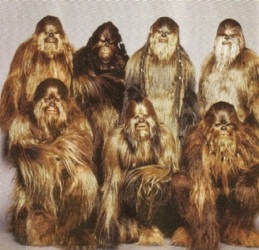 When I visited Honey Island Swamp, in the 1980s, the Star Wars movies had obviously made an impact on the local naming of the Honey Island Swamp Monster. Locals in the area some miles outside of New Orleans, Louisiana, were calling their Honey Island cryptid, casually, for example, by naming their small swamp boats (wrongly spelled) “Wookie.” The Star Wars movies came first, and there is no evidence that the Honey Island Swamp Monster was called a “Wookie” or a “Wookiee” before 1977.

